Painting a Bathroom in Poole: Moisture-Resistant Preparation and Finish Tips
Painting a bathroom in Poole? Learn how to handle moisture, prep walls properly and choose the right paint. Tips from KC Decorators, serving Poole, Bournemouth and Dorset.

Why Bathroom Painting in Poole Is a Different Challenge Entirely
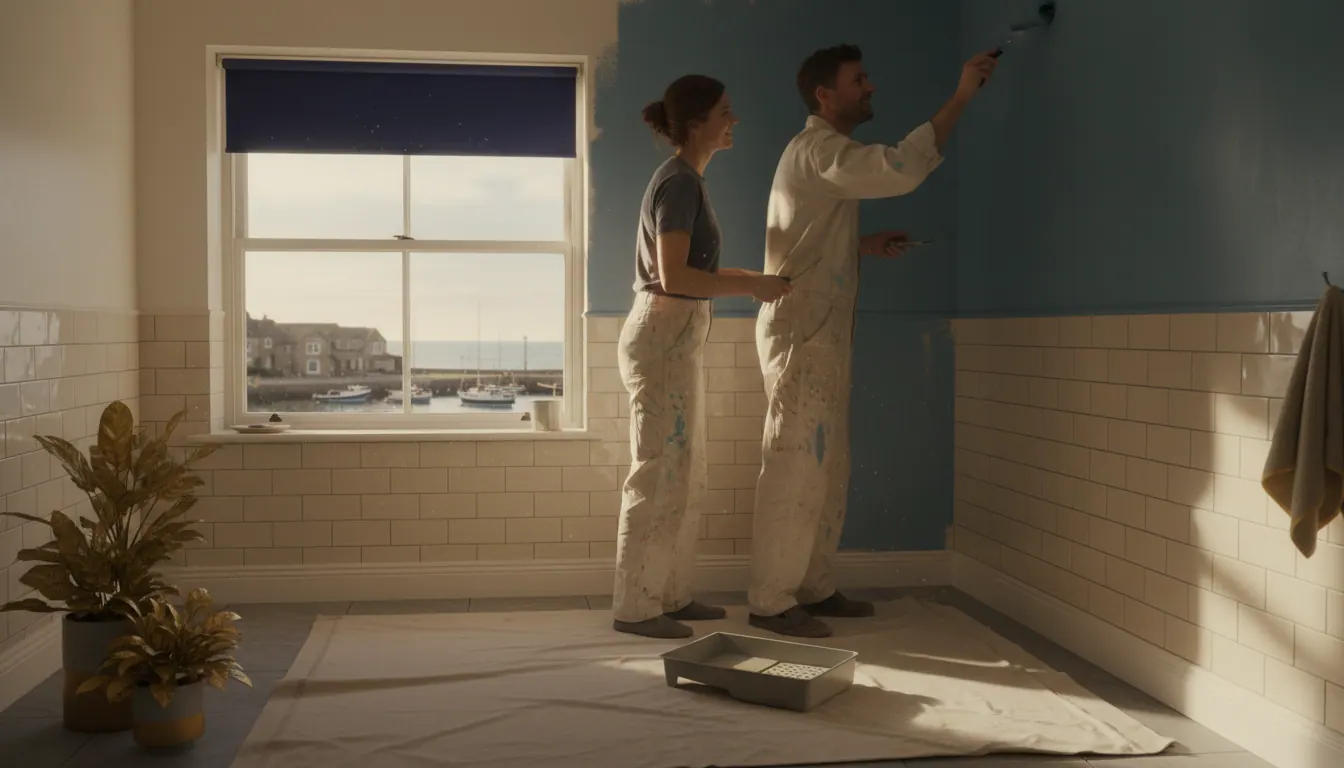
Bathrooms are the hardest room in the house to paint well. Steam, condensation and salt-laden coastal air combine to create conditions that will expose every shortcut. In Poole and along the Bournemouth coastline, we see it constantly: paint that has blistered away from the ceiling, mould creeping into corners, or a colour that looked crisp at first but started peeling within a year.
The good news is that none of that is inevitable. With the right preparation, the right products and a bit of patience, a bathroom can hold a beautiful, clean finish for years. This guide covers everything you need to know before a single brushstroke goes on the wall.
Understanding Moisture: The Real Enemy Behind Bathroom Paint Failure
Most paint failures in bathrooms come down to moisture getting somewhere it should not be. That happens in two main ways: poor preparation before painting, and the wrong paint being used in the first place.
In older homes across Poole, Wareham and Broadstone, walls are often porous. Tiles may have been removed, leaving adhesive residue or bare plaster. Previous layers of standard emulsion may have been applied over and over without ever being properly keyed or primed. When steam rises from a shower or bath, it finds those weak points and pushes straight through.
Coastal humidity makes this worse. Poole Harbour and the coastline around Bournemouth mean that even on dry days, the ambient moisture level is higher than it would be inland. That is not a reason to worry, but it is a reason to be thorough.
How to Prep Your Bathroom Before Painting
Preparation is where the job is won or lost. We spend more time on prep than on painting itself, and that is exactly as it should be.
Here is what proper bathroom prep looks like:
- Remove mould before you do anything else. Painting over mould does not kill it. Treat affected areas with a dedicated mould-killer solution and allow it to dry fully before touching the walls.
- Sand back any flaking or loose paint. Feather the edges so there is no ridge where old paint ends and bare wall begins.
- Fill any cracks or holes. Use a flexible filler that can cope with slight movement, which is common in older Poole terraces and converted flats.
- Clean the walls thoroughly. Grease, soap residue and limescale will prevent paint from bonding. Sugar soap is the standard tool here.
- Apply a stain-blocking primer to any water-stained or previously mouldy areas. This step is skipped far too often and it is one of the main reasons paint fails early.
- Check ventilation. If the extractor fan is weak or the room has no window, no paint job will last as long as it should. We always flag this to customers before we start.
If you are stripping old wallpaper before painting a bathroom, take a look at our guide on stripping wallpaper the right way, which covers preparation in detail for Poole and Bournemouth homes.
Choosing the Right Paint for a Bathroom Ceiling and Walls
Not all paints are created equal, and this matters most in a bathroom.
For ceilings, you cannot use standard matt emulsion and expect it to last. A bathroom ceiling sits directly above the steam source. You need a paint specifically formulated for high-humidity environments, typically labelled as bathroom paint or moisture-resistant emulsion. These contain fungicide and are formulated to resist condensation.
For walls, the same principle applies. Bathroom-specific paints tend to have a slight sheen, which makes them easier to wipe down and less prone to absorbing moisture. A completely flat matt finish looks beautiful but will not hold up well directly above a bath or shower.
For the area immediately around a shower tray or bath, paint alone is not the right solution. That zone needs tiles or a suitable waterproof panel. Paint, even specialist bathroom paint, is not designed to be in direct and repeated contact with water. We are always honest with customers about this so expectations are set correctly from the start.
A quick answer to something we are asked regularly: you should not add water to bathroom paint to thin it. Bathroom paints are formulated at a specific consistency to maintain their moisture-resistant properties. Diluting them compromises that. If the paint feels too thick to apply, the usual cause is that the tin has been stored in a cold environment. Allow it to reach room temperature and stir thoroughly first.
Colour Choices That Work in Poole Bathrooms
Bathrooms in Poole homes tend to be on the smaller side, particularly in the terraces around Parkstone, Canford Heath and Hamworthy, and in the flats and conversions closer to Bournemouth. Colour choice matters in a small space.
Soft whites, pale greys and warm off-whites remain the most popular choices we are asked to work with, and for good reason: they reflect light, make the room feel larger and show off a clean finish. Deeper tones, navy, forest green, charcoal, are increasingly popular as an accent or on a single wall, and they can look genuinely striking in a well-lit bathroom with good contrasting fixtures.
The key is to look at how much natural light the room gets before committing. A north-facing bathroom in a Wareham cottage will absorb a deep colour very differently to a south-facing bathroom in a Christchurch new-build.
For more ideas on working with colour in smaller rooms, our article on choosing paint colours for small rooms is a useful starting point.
What Our Customers Say
Jo Hatch left us this review after Aaron decorated her son's bedroom and a bathroom:
"What can I say, not only was he super helpful and polite, Aaron did a brilliant job of decorating our son's bedroom and a bathroom! Would highly recommend and we've already got the next lot of decorating lined up for him"
That last part, already booking the next job before the current one is finished, is something we hear often. It comes down to one thing: turning up when we say we will, leaving the space cleaner than we found it, and delivering a finish that genuinely looks professional. All 18 Facebook reviewers recommend KC Decorators, and we intend to keep it that way.
Ventilation: The Factor Most People Overlook
Even the best bathroom paint job will deteriorate quickly if the room is not properly ventilated. Steam has to go somewhere. If it cannot escape through an extractor or window, it will settle on every surface, including the ceiling and upper walls.
Before we start any bathroom job in Poole, Bournemouth or elsewhere in Dorset, we check the ventilation situation. If there are obvious issues, we let the homeowner know. It is not our place to fix the extractor fan, but it is absolutely our place to be honest about whether the conditions are right for the paint to last.
Simple habits make a big difference too: opening a window after a shower, running the extractor during and for ten minutes after bathing, and wiping down surfaces regularly. These things extend the life of any paint job considerably.
Frequently Asked Questions
Can you use any paint on a bathroom ceiling? No, and this is one of the most common mistakes we see. Standard matt emulsion is not designed for the steam and condensation a bathroom ceiling faces. You need a paint specifically labelled as moisture-resistant or bathroom-grade. These contain fungicide and are formulated to handle repeated exposure to humidity without blistering or allowing mould to take hold.
How should I prep my bathroom before a decorator comes in? Clear personal items from shelves and surfaces, remove any loose fixtures you can safely take down, and flag any known damp patches or mould to us before we start. We handle all the surface preparation, including cleaning, sanding and priming, but knowing about problem areas in advance means we can bring the right materials on the first day. For a full checklist, take a look at our article on preparing your home for a decorator.
Can you get waterproof paint for a shower? There are paints marketed as waterproof, but we would always advise caution about using paint as the primary waterproofing in a shower enclosure. Paint is not a substitute for properly sealed tiles or waterproof panels in a wet zone. For the walls and ceiling beyond the immediate shower area, a good-quality bathroom paint will handle steam and condensation well. We are always upfront about this with customers so there are no surprises later.
Should I add water to bathroom paint to make it easier to apply? No. Bathroom paints are formulated at a specific consistency that maintains their moisture-resistant and anti-mould properties. Diluting them weakens those properties and can lead to early failure. If the paint seems too thick, it is usually because it is cold. Bring it to room temperature and stir thoroughly before use.
Get a Free Quote for Your Bathroom in Poole, Bournemouth or Across Dorset
If your bathroom is looking tired, showing signs of mould or peeling paint, or you simply want a fresh, clean finish that will actually last, we would be glad to help. We cover Poole, Bournemouth and across Dorset, including Wareham, Broadstone, Parkstone, Canford Heath, Hamworthy, Christchurch and Ferndown.
Every quote is free, with no obligation. Send us a few photos through the contact form or call us on 07778 228478 and we will talk you through what the job involves before anything is agreed.